December 18, 2025 · 4 min read
Why Workshops Work Better Than Training Sessions
Training teaches people how a tool works. Workshops help teams figure out how to work better. The difference in results is significant.
Summary
Training teaches people how tools work. Workshops help teams solve their actual problems. The difference in retention and results is dramatic — people remember solutions they built themselves, not presentations they sat through.
Listen to article
There is a meaningful difference between training and workshops. It is not just about words.
Training is instruction. Someone stands at the front of the room and explains how a tool works. People take notes, follow along, and leave with knowledge they may or may not use.
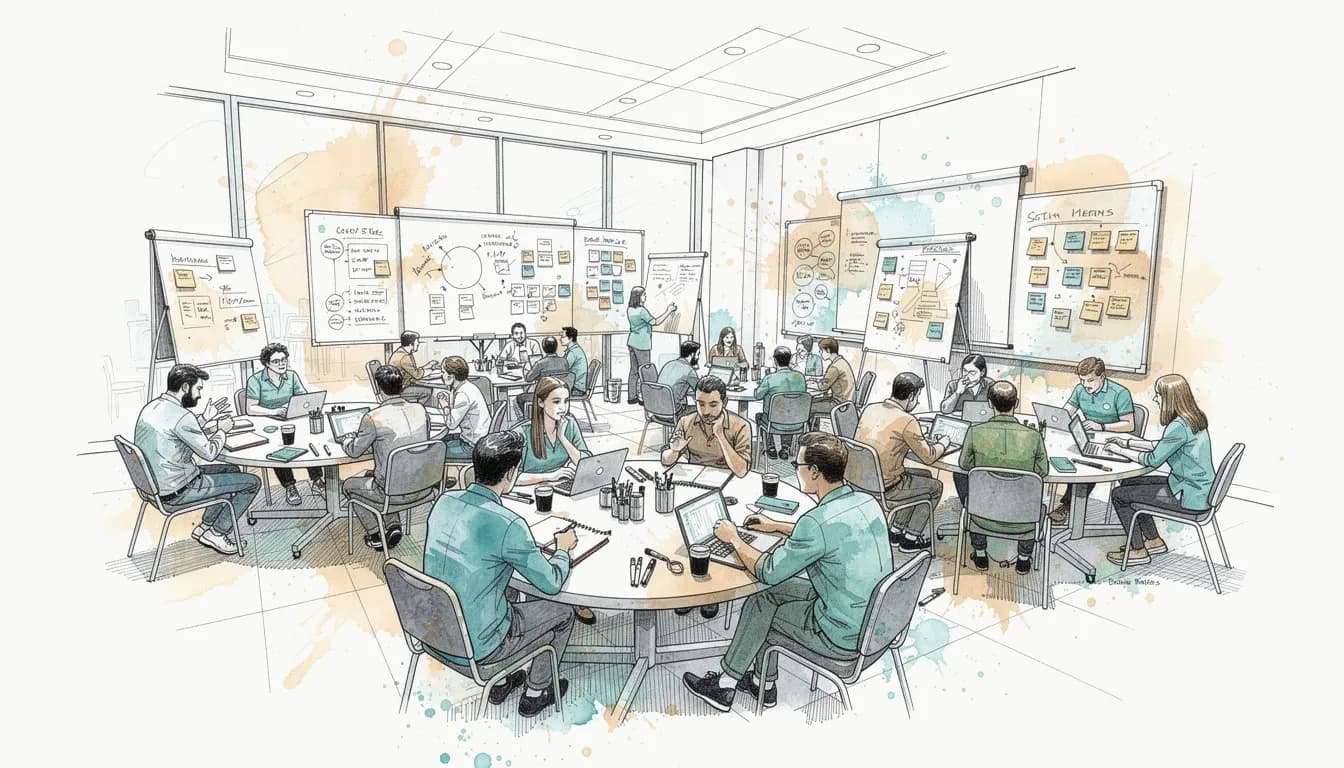
Workshops are collaborative problem-solving sessions. The team works on their actual challenges, with guidance. They leave with solutions they have already started implementing.
The retention problem
Think about the last training session you attended. How much do you still remember? For most people, the answer is: very little.
This is not because the training was bad. Learning without immediate practice does not stick. You can teach someone every feature of a project management tool, but if they go back to their desk and keep working the old way, nothing changes. We see this pattern constantly — it is one of the main reasons teams fail to adopt new tools.
What happens in our workshops
When we run a workshop, we do not start with tools or features. We start with the team's actual work.
What are you trying to accomplish this quarter? Where does work get stuck? What takes longer than it should?
The team maps their own processes. They identify their own bottlenecks. Then together, we design solutions — often using AI and automation — that fit how they actually work.
By the end of the day, the team has not just learned something new. They have built something they can use immediately.
The multiplier effect
Something important happens when a whole team goes through a workshop together. They develop shared language and shared understanding. Instead of one person trying to convince everyone else to change, the whole team has been part of designing the change.
Traditional approach
One person
trained
Tries to
convince
Team
resists
Workshop approach
Whole team
workshops
Shared
understanding
Team
adopts
This is why workshops produce lasting results and training often does not. The team owns the outcome because they built it together.
When training makes sense
Training has its place. If your team needs to learn a specific AI tool and they are already motivated to use it, training is efficient. But if the goal is to change how a team works, a workshop will take you further, faster.
The investment is similar. The outcomes are very different. See how this works in practice with real teams in Phnom Penh.
Keep reading